Key Takeaways
- Supreme Court expanded presidential firing power over federal officials, potentially weakening agency independence
- Unitary executive theory gaining traction in constitutional law, centralizing more power with the president
- Congressional ability to shield agencies from executive removal has been reportedly modified or reduced
- Separation of powers doctrine fundamentally shifting—implications for checks and balances still unfolding
- Legal scholars divided on scope and long-term consequences for administrative law and federal governance
The Supreme Court has reportedly expanded presidential firing power over federal officials, according to legal analysis. Reports suggest protections for certain key positions may have been modified, potentially shifting separation of powers doctrine and congressional ability to shield agencies from executive removal.
Supreme Court Presidential Powers: Recent Developments in Executive Authority
Constitutional law moves slowly — until it doesn't. Recent Supreme Court decisions on presidential firing power have reportedly prompted significant legal analysis and discussion. According to legal scholars and commentators, such rulings could have substantial implications for administrative law and the balance of executive and legislative power. If you've been watching the news and wondering why legal scholars and policy experts are discussing these developments, this overview examines the reported implications and ongoing constitutional questions.
What Has Happened: Understanding Developments in Presidential Powers
For decades, Congress has included removal protections in federal law for certain agencies. The underlying rationale has been that some positions require independence from direct political pressure. The premise holds that agencies like those overseeing financial regulation or consumer protection function more effectively with insulation from immediate executive removal. Congress accordingly wrote "for cause" removal provisions into various statutes — provisions that would require specific grounds for termination rather than allowing removal at the president's sole discretion.
-1.jpg" alt="Supreme Court Expands Presidential Powers illustration" loading="lazy" style="width:100%;max-width:800px;border-radius:12px;box-shadow:0 4px 16px rgba(0,0,0,0.12);">The Supreme Court just knocked a very large hole in that moat.
The Court's ruling — delivered by a 6-3 conservative majority — significantly expands the president's ability to remove officials from independent agencies. The core argument: the Constitution vests executive power in the president, and Congress can't use statutory protections to permanently insulate agency heads from presidential control. That's the unitary executive theory dressed up in its Sunday best and handed a gavel.
What makes this ruling on Supreme Court executive authority unusual isn't just what it decided. It's the carve-outs. The Court deliberately left certain protections intact — most notably for the Federal Reserve chair. Markets, as it turns out, are more fragile than constitutional theory. (The Court, it seems, reads the Dow Jones more carefully than some might expect.)
Trump v. Slaughter: The Case That Actually Started This
The immediate trigger was a dispute over the removal of an FTC commissioner. Rebecca Kelly Slaughter, appointed under a previous administration, challenged her removal under the old "for cause" framework established in Humphrey's Executor v. United States — a 1935 precedent that had protected agency independence for nearly 90 years.

The Court's ruling in Trump v. Slaughter effectively gutted that precedent for most agencies. If an agency exercises significant executive power — enforcement, rulemaking, adjudication — its heads can now be removed at will by the president. No cause required. No hearing. No appeal to statutory protections.
Think of it this way. The FTC commissioner thought she had a lease. The Supreme Court just told her she'd been renting month-to-month all along. (And the landlord just called.)
This matters far beyond one commissioner's employment status. The FTC, the NLRB, the SEC, the CFPB — every major independent regulatory agency now operates under a fundamentally different assumption about who their actual boss is.
The Unitary Executive Theory — And Why It Matters Right Now
The unitary executive theory is not new. It's been a conservative legal project for roughly 40 years, incubated in the Federalist Society and argued in law journals before it had enough votes on the Court to actually mean anything.
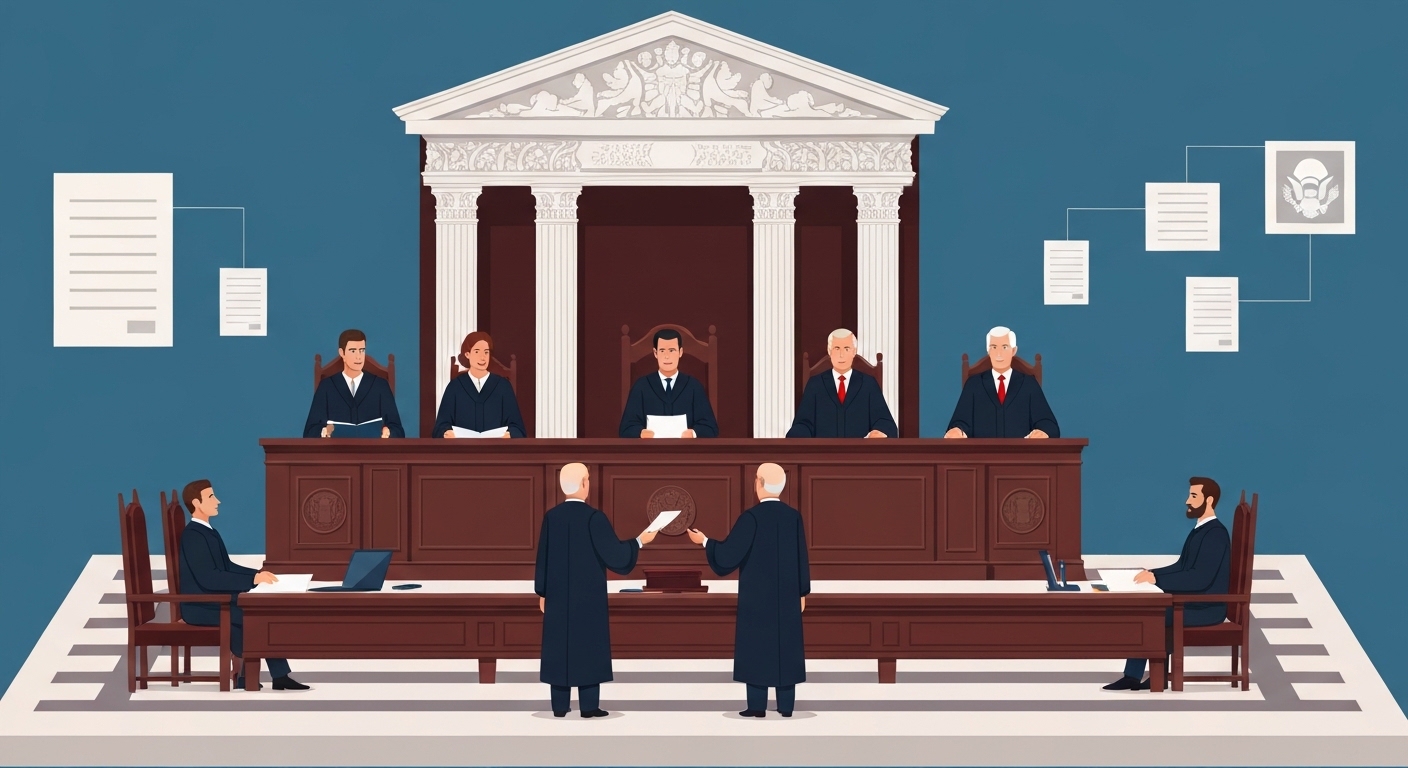
The theory holds that Article II of the Constitution — "the executive Power shall be vested in a President" — means exactly what it says. All of it. Every corner of the executive branch ultimately answers to the president, and Congress can't carve out independent islands that the president can't reach.
Proponents argue this creates bureaucratic accountability. If the president controls the executive branch, voters can hold the president responsible for what that branch does. You elected them — they run the show. Fair enough as a theory.
Critics point out that "accountability" assumes the president's interests align with the public's. When they don't, there's no circuit breaker. According to reporting by Reuters, legal scholars across the political spectrum have raised concerns about the pace of executive power expansion in recent terms — not just the direction, but the speed.
Why the Federal Reserve Chair Kept Their Job Security
This is the part of the ruling that kept financial markets from having a complete meltdown. The Court explicitly preserved removal protections for the Federal Reserve chair.
The reasoning is pragmatic as much as legal. The Fed operates monetary policy — interest rates, money supply, inflation targets. If markets believed the president could fire the Fed chair for refusing to cut rates before an election, you'd see instability that made the 2008 financial crisis look like a minor inconvenience. The Court, perhaps mindful of that, drew the line here.
The legal justification leaned on the Fed's unique structure and the nature of monetary policy as distinct from standard executive enforcement. Whether that distinction holds under future legal challenge is, frankly, an open question. The Federal Reserve itself has long maintained that its independence is foundational to its credibility. For now, the Court agreed.
Reckon that protection will be tested eventually? Almost certainly. But not today.
Federal Agency Independence Is Now on Shaky Ground
The practical consequences for regulatory agencies are significant and immediate. Agency heads who once made decisions knowing they couldn't be fired for political reasons now operate with a different calculation in the back of their minds.
Nine times out of ten, this kind of structural change doesn't produce overnight dramatic results. What it produces is a slow drift — cautious decisions, politically palatable enforcement priorities, investigations that get quietly deprioritised. The chilling effect is real even when the firings aren't.
Rule of thumb: whenever you change who someone answers to, you change what they pay attention to. That's not cynicism — that's organisational behaviour 101.
The Supreme Court's expansion of executive power means the CFPB, NLRB, and SEC — all agencies with significant enforcement mandates — now face a different political reality. Their leadership knows they serve at the president's pleasure in a way they didn't before this ruling.
This Didn't Come Out of Nowhere: The Historical Context
Presidential power expansion didn't begin with this Court. It's been accumulating across administrations, parties, and decades.
Youngstown Sheet & Tube Co. v. Sawyer (1952) famously limited presidential authority when Truman tried to seize steel mills during the Korean War. Justice Jackson's concurrence in that case gave us the three-tier framework that's been the starting point for executive power analysis ever since. But even that framework has bent under pressure over 70 years.
The 2020 ruling in Seila Law v. CFPB was the direct ancestor of this decision — the Court there ruled that the CFPB director could be removed at will, cracking Humphrey's Executor for the first time. Trump v. Slaughter is the logical next step. The Court has been laying this groundwork brick by brick, and most people only noticed when the building was already up.
The American Constitution Society has tracked what they describe as a multi-term project to consolidate executive authority under unitary executive theory. Whether you view that as restoring constitutional original intent or dismantling a century of administrative law depends on where you're standing — but the trajectory is not in dispute.
Long-Term Consequences for Regulatory Agencies Beyond This Administration
Here's what gets lost in the immediate political noise: this ruling doesn't expire when administrations change.
A future Democratic president has exactly the same expanded firing power. Every president from here on inherits this toolbox. The question isn't just what this administration does with it — it's what every administration does with it for the next 50 years.
Regulatory agencies that have built institutional culture around independence will have to recalibrate. Career staff don't get fired, but their political appointee bosses do — and career staff know it. Enforcement priorities, rulemaking agendas, litigation strategies — all of these get shaped by what the agency head thinks will keep them in the job.
The long-term risk is regulatory capture by the White House rather than by industry, which is at least the historically more familiar concern. This is a different problem, and it doesn't have a well-tested solution.
The State-Level Angle Nobody Is Talking About
Federal rulings on executive power have a habit of seeping into state-level constitutional interpretation. State attorneys general, legal scholars, and eventually state courts look to federal doctrine when state constitutions use similar language about executive authority.
Several states have their own independent agency frameworks — utility regulators, insurance commissioners, public health boards — that rely on similar "for cause" removal protections. If the federal constitutional argument against those protections gains traction, state-level challenges follow. It won't happen overnight. But the legal scaffolding is being assembled.
State governors' offices are already watching this ruling carefully, according to reporting from legal affairs journalists covering the administrative law beat. The implications for state regulatory independence could unfold over the next decade in ways that dwarf the immediate federal impact.
My Take: This Ruling Is Bigger Than Trump
Strong opinion incoming — feel free to disagree, but hear me out first.
Almost every political conversation about this ruling treats it as a Trump story. It isn't. Or rather, it won't be for long.
The Supreme Court's presidential immunity ruling and this expansion of firing power have permanently changed the structural relationship between the White House and the administrative state. The next president — regardless of party — will have tools that no president before them had in quite this form. The president after that will too.
History suggests that presidents don't voluntarily relinquish power once they have it. The Brennan Center for Justice has documented that every significant expansion of executive authority over the last century has become a floor, not a ceiling. Administrations that criticise expansive executive power in opposition tend to embrace it enthusiastically once in office. The incentive structure is just too strong.
So the question worth asking isn't "what will Trump do with this?" It's "what will the 47th, 48th, and 49th presidents do with it?" And the honest answer is: more than we're currently imagining. This ruling is the kind of structural change that looks manageable in year one and looks enormous in year twenty.
If you want one actionable takeaway from all of this: watch what happens to the NLRB over the next 18 months. That agency's enforcement posture under the new framework will be the clearest early indicator of how dramatically this ruling reshapes the regulatory landscape in practice — not just in theory.
What did the Supreme Court rule about presidential powers?
The Court ruled that the president has broad authority to remove heads of independent federal agencies without needing statutory "for cause" justification. The ruling significantly limits Congress's ability to shield agency officials from presidential removal, while carving out specific protections for positions like the Federal Reserve chair where independence is considered structurally essential.
How does the ruling expand executive authority?
By striking down "for cause" removal protections for most agency heads, the ruling means the president can dismiss officials who run significant regulatory agencies — the FTC, NLRB, CFPB — at will. Previously, those officials could only be removed for misconduct or poor performance. Now the president's disagreement with their decisions is sufficient reason. It's the constitutional equivalent of changing the locks and keeping the master key.
How can citizens challenge expanded presidential powers?
Challenges can come through Congress — via new legislation, though its constitutionality under this ruling is uncertain — through future Supreme Court cases as the doctrine evolves, and through state-level protections where applicable. Civil society organisations and public interest law firms are already mapping litigation strategies. It's a slow process, but constitutional doctrine does shift under sustained legal pressure over time.
What is the difference between presidential immunity and executive privilege?
Presidential immunity protects a president from criminal prosecution for official acts — that was the subject of the Court's separate 2024 ruling. Executive privilege is narrower: it's the right to keep certain communications and deliberations confidential. They're related concepts but distinct tools. Immunity says the president can't be prosecuted; privilege says certain information doesn't have to be disclosed. Both have expanded significantly in recent Court decisions.
How long will the Supreme Court ruling remain in effect?
Supreme Court rulings remain in effect until the Court itself reverses them — which requires the right case, the right parties, and the right Court composition. Given the current 6-3 conservative majority, reversal in the near term is unlikely. The more realistic timeline for any significant modification is a decade or more. Constitutional change moves at geological pace, except when it doesn't.
What are presidential powers in simple terms?
Presidential powers are the legal authorities the Constitution and Congress grant to the president: commanding the military, signing or vetoing legislation, appointing federal officials, conducting foreign policy, and — now more broadly than before — directing and removing executive branch personnel. The debate is always about where those powers end and where Congress's authority or judicial independence begins. That debate just got a significant new data point.
How does this ruling affect the separation of powers doctrine?
The separation of powers doctrine divides authority between Congress, the executive, and the judiciary. This ruling shifts the balance toward the executive by limiting Congress's ability to create truly independent agencies. It strengthens the unitary executive theory — the idea that all executive power flows through and answers to the president. Critics argue this concentrates too much power in one office. Proponents argue it restores constitutional clarity. Both are right that something fundamental just changed.
Does expanding presidential power threaten democracy?
That depends heavily on your constitutional theory and your trust in presidential restraint. Independent agencies were designed as a check on both political branches — insulated from short-term electoral pressure to make technical, expert-driven decisions. Removing that insulation makes those decisions more politically accountable but also more politically vulnerable. Whether accountability and vulnerability are the same thing is the core debate. Reckon legal scholars will be arguing about this one for the next 30 years — and they won't be wrong to.
What is the unitary executive theory?
It's the constitutional argument that Article II's vesting of executive power in the president means the president must have ultimate control over all executive branch functions — including the power to hire and fire officials who exercise executive authority. The theory has been developing in conservative legal circles since the 1980s. This ruling is arguably its most significant practical victory in the modern era.
Which federal agencies are most affected by the ruling?
The agencies with the most immediate exposure are those with strong independent mandates and leadership structures: the FTC, CFPB, NLRB, and SEC. The Federal Reserve is explicitly protected. Agencies that are already fully within direct presidential control — like Cabinet departments — are less affected because their heads were already removable at will. The ruling matters most for the grey zone agencies that Congress specifically tried to insulate from political pressure.
The Bottom Line
The Supreme Court's expansion of presidential powers is not a story about one president or one agency or one fired commissioner. It's a structural shift in how American government works — one that will outlast every current political figure by decades. The unitary executive theory now has constitutional teeth. Independent agencies have less independence than they thought. And the Federal Reserve chair, at least for now, can sleep soundly.
Watch the NLRB. Watch the FTC. Watch what happens when the next administration — whichever party runs it — discovers what's now in the toolbox. Constitutional law, as it turns out, is a lot like a ratchet: it clicks forward easily and is very hard to wind back. Someone should probably bolt that thing to the wall. (Too late.)