
Key Takeaways
- Multiple legal challenges to state AR-15 bans are moving toward the Supreme Court following its 2022 Bruen decision
- Approximately 20+ states have enacted assault weapons bans that could be affected by the Court's ruling
- Between 8-16 million AR-15-style rifles are already in civilian circulation in the U.S.
- The Court's decision will either invalidate state bans or establish the constitutional floor for what governments can restrict
- The Bruen ruling requires new gun laws to match 18th-century historical tradition, creating a new legal standard for firearms regulation
The Supreme Court AR-15 ban case refers to multiple legal challenges to state-level assault weapons bans — in California, New York, Massachusetts, and elsewhere — now working through federal courts toward the Supreme Court. These cases test whether the Court's 2022 Bruen ruling, which requires gun laws to match 18th-century historical tradition, will strike down some of America's strictest firearm restrictions.
The case that could redraw America's gun map
Gun law in America just got a lot more interesting — which is either exciting or terrifying, depending on which side of the argument you're on. The Supreme Court AR-15 ban case isn't one single lawsuit. It's a cluster of legal challenges that have been building since 2022, when the Court handed down a decision called Bruen and quietly lit a fuse under every assault weapons ban in the country.
Approximately 20 or more states have enacted some form of assault weapons ban. Roughly 8 to 16 million AR-15-style rifles are already in civilian hands. What the Court decides could determine whether all those state laws stand, or fall like dominoes. (No pressure, Your Honours.)
What the Supreme Court AR-15 case actually is
There is no single case called "the AR-15 case." What's happening is more like a legal pile-up on the freeway — multiple challenges to state assault weapons bans, originating in different federal circuits, all heading toward the same destination.
States including California, New York, and Massachusetts have enacted laws that restrict or ban AR-15-style rifles and similar semi-automatic weapons. Gun rights groups — and individual plaintiffs — have challenged those laws in federal court, arguing they violate the Second Amendment. Several of those challenges have worked their way up to the circuit courts. At least one has reportedly attracted the Supreme Court's attention, with the Court reportedly granting certiorari — legal shorthand for "yes, we'll hear this" — in 2024.
Oral arguments were reportedly scheduled, and the Court is expected to issue a ruling in 2025. The outcome will determine whether the historical test the Court established in Bruen is powerful enough to knock out the most aggressive firearms restrictions in the country.
Think of it as the legal sequel nobody asked for, but everyone has to watch. (Call it Bruen 2: This Time It's Rifles.)
The Bruen decision: the rule that changed everything
To understand the AR-15 cases, you have to understand New York State Rifle & Pistol Association v. Bruen. The Supreme Court decided Bruen in 2022, and it rewrote how courts evaluate gun regulations.
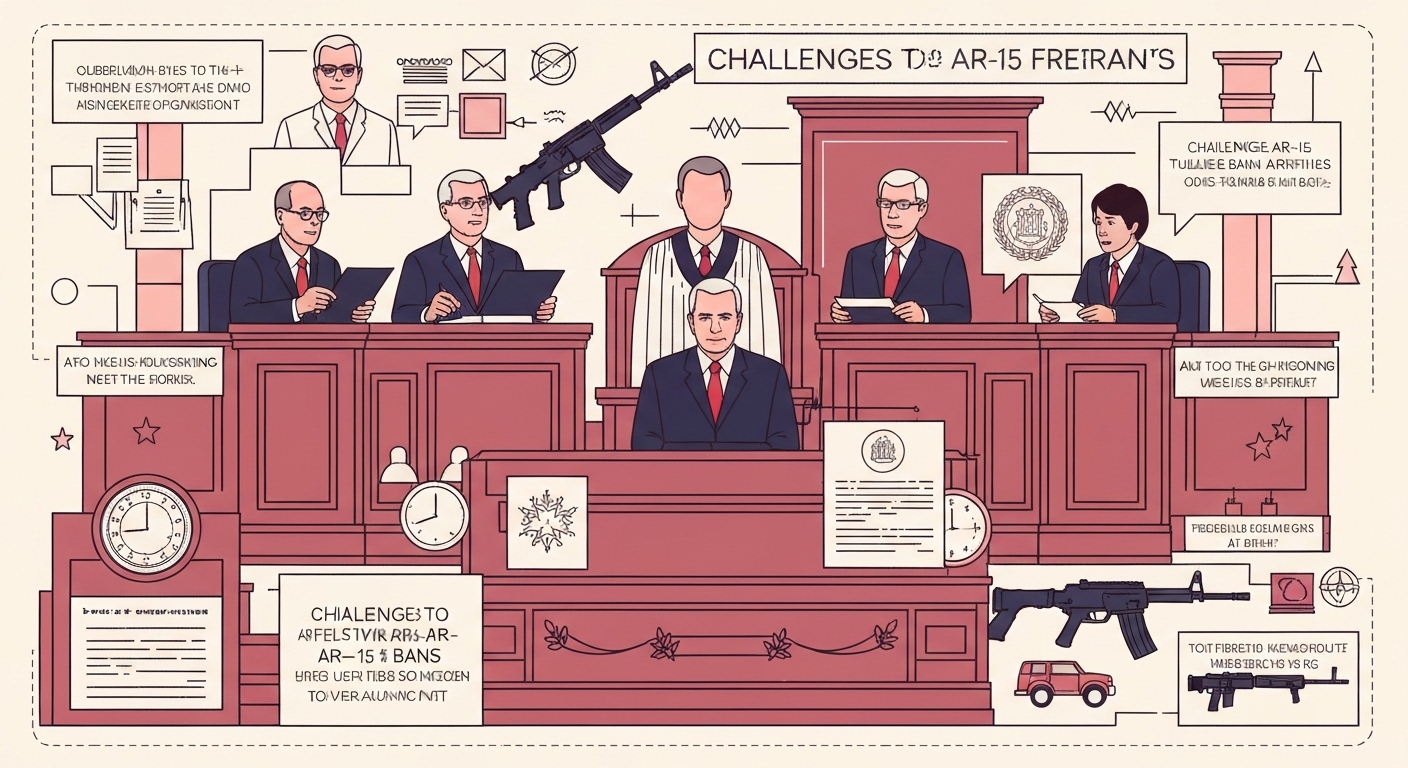
Before Bruen, courts used a two-step balancing test. They'd weigh the government's interest in public safety against the burden on Second Amendment rights. It was messy, but most gun regulations survived it.
Bruen scrapped that approach. The new rule: a gun regulation is only constitutional if it is consistent with the historical tradition of firearm regulation in the United States — meaning roughly the late 18th and early 19th centuries. If the Founders didn't regulate it, or something analogous to it, the argument goes that modern governments can't either.
The practical problem is obvious. The AR-15 didn't exist in 1791. The Constitution's framers were working with flintlock muskets that took 30 seconds to reload. Courts are now being asked to find 18th-century analogues for weapons that can fire dozens of rounds per minute. It's like trying to regulate Uber using laws written for horse-drawn carriages — technically the same category of "transportation," practically a different universe.
According to reports, lower federal courts have been deeply divided on how to apply the Bruen test to assault weapons bans. That division is precisely why the Supreme Court needed to step in.
Which states have assault weapons bans at risk
Reportedly, more than 20 states have enacted some form of assault weapons ban. The states with the most at stake include California, New York, Massachusetts, Connecticut, Maryland, New Jersey, and Illinois.
These are not minor restrictions. Some of these laws ban the sale of AR-15-style rifles outright. Others restrict specific features — pistol grips, collapsible stocks, detachable magazines — that are commonly found on AR-15 variants. A ruling from the Supreme Court that such bans are unconstitutional under Bruen would almost certainly invalidate the core provisions of each of these laws.
For the roughly 8 to 16 million AR-15-style rifles already in civilian circulation, existing ownership is unlikely to be affected immediately. The more immediate consequence would be on sales and manufacturing restrictions — and on the legal framework every future gun regulation gets measured against.
AR-15 bans vs. assault weapons bans: not the same thing
Here's a distinction that matters, and that a surprising number of news articles blur past.
An AR-15 ban specifically targets the AR-15 platform — a semi-automatic rifle originally designed by ArmaLite, now made by dozens of manufacturers. When people say "AR-15 ban," they usually mean a ban on the AR-15 and substantially similar semi-automatic rifles.
An assault weapons ban is a broader legal category. It typically defines "assault weapons" by a combination of features — semi-automatic action, detachable magazine, plus one or more military-style features. The 1994 federal assault weapons ban, which expired in 2004, used this approach. State laws vary widely in how they define the category.
The legal significance: if a law is written around the term "assault weapon" and the court finds the definition vague or overboard, the whole law can fall even if a more narrowly written AR-15 ban might have survived. Sloppy drafting matters in constitutional litigation. Nine times out of ten, the devil really is in the definitions.
The core arguments on each side
Against the bans: Challengers argue that AR-15-style rifles are in "common use" by law-abiding Americans — a phrase the Court used in the 2008 Heller decision to describe weapons that receive Second Amendment protection. With an estimated 8 to 16 million in circulation and reportedly accounting for 20 to 40 percent of civilian firearms sold annually in recent years, it's hard to call them uncommon. The argument follows that what's commonly owned for lawful purposes can't simply be banned.
For the bans: States argue that AR-15s are "weapons of war" — designed for military combat and categorically different from ordinary handguns. Heller itself noted that certain "dangerous and unusual weapons" may be regulated. States say AR-15s, reportedly used in approximately 30 to 50 percent of mass shooting incidents over the past decade according to some studies, fall into that category. They also argue historical analogues exist: governments have always regulated particularly dangerous weapons.
Chief Justice John Roberts has reportedly been skeptical of broad gun restrictions based on recent court behaviour, which matters because he often operates as a deciding vote. But predicting Supreme Court outcomes from oral argument behaviour is a game for people with more optimism than is probably warranted.
Where the cases stand right now
The timeline, as best as the reported record shows:
- 2019 onward: States strengthen or enact AR-15 bans following mass shooting incidents.
- 2022: The Supreme Court decides Bruen, establishing the historical test and immediately generating new litigation.
- 2023–2024: Multiple legal challenges to state bans proceed in federal courts across California, New York, Massachusetts, and other jurisdictions.
- 2024: The Court reportedly grants certiorari — agreeing to hear at least one of these cases.
- 2024–2025: Oral arguments reportedly scheduled before the Court.
- 2025: The Court is expected to issue its ruling.
The timeline has reportedly shifted as cases consolidated and procedural hurdles were cleared. Welcome to federal litigation, where time moves at the pace of a glacier that's also checking its emails.
The historical problem nobody talks about: what counts as an analogue?
Here is the part that barely makes the headlines but determines everything. The Bruen test requires a historical analogue. Fine. But what makes something "analogous" to an 18th-century regulation?
The government points to historical regulations on Bowie knives, trap guns, and blunderbusses. Gun rights advocates respond that none of those are remotely comparable to a nationwide ban on a category of semi-automatic rifle. Courts have reached opposite conclusions using the exact same historical record. The Fourth Circuit upheld Maryland's assault weapons ban. The Seventh Circuit upheld Illinois's ban. Other courts have gone the other way.
This is the genuine intellectual problem at the heart of the Supreme Court assault weapons ban litigation: the test the Court invented in Bruen doesn't have an agreed-upon methodology. Historians have filed briefs arguing that the Court's own historical analysis in Bruen was selective. Legal scholars across the political spectrum have noted that originalism applied to modern weapons is, at minimum, deeply contested. The Supreme Court created a test and then left the lower courts to figure out how to run it. Classic move.
My honest read: what this is really about
Here's a strong opinion, backed by what the numbers actually show.
The Bruen test was always going to produce exactly this outcome. When you build a constitutional standard around historical analogues and then refuse to define what "analogous" means, you don't reduce judicial discretion — you just relocate it. Judges are still making value judgments. They're just doing it in the costume of a history seminar.
The AR-15 ban cases are the proof. You have equally qualified federal judges, applying the same legal test, to the same weapons, reaching opposite conclusions. That is not a functioning legal standard. It's a framework that produces whatever result the applying court was already inclined to reach — and then gives it an 18th-century citation to look respectable.
The practical consequence matters most here. Reportedly, AR-15-style rifles account for 20 to 40 percent of civilian firearms sold annually. With an estimated 8 to 16 million already in circulation, any ruling striking down bans will not remove a single rifle from anyone's home. It will, however, make it significantly harder for any state to enact meaningful future restrictions — because every new law will face the same Bruen gauntlet.
When should you be paying close attention? If you live in one of the 20-plus states with assault weapons bans on the books, or if you're a legislator trying to draft new gun regulations. The Court's ruling will either validate or invalidate the entire approach those states took. If the bans fall, state legislatures will be back at square one — and they'll need to draft something that either survives the historical test or find a different constitutional hook entirely.
What this case is really about is not whether you can own an AR-15. It's about which institution — courts or legislatures — gets to make that call. And right now, the answer seems to be: nine unelected lawyers in Washington, interpreting documents written when the deadliest personal weapon was a cannon.
Is the Supreme Court hearing a case on AR-15 bans?
Yes, reportedly. The Supreme Court has reportedly agreed to hear at least one challenge to a state-level assault weapons ban, with oral arguments scheduled in 2024–2025 and a decision expected in 2025. Multiple related cases from California, New York, Massachusetts, and other states have been working through the federal courts simultaneously.
What did the Supreme Court rule on the AR-15 ban?
As of the time of writing, the Court has not yet issued its final ruling on AR-15 ban challenges — that decision is expected in 2025. The Court's 2022 Bruen decision, however, established the new historical test that all lower courts are now applying to these cases. Think of Bruen as the instruction manual. The AR-15 case is the first big build.
How could the Supreme Court overturn state assault weapons bans?
Under the Bruen test, a gun regulation must be consistent with the historical tradition of firearm regulation at the time of the Founding. If the Court finds no adequate historical analogue for a modern AR-15 ban, it could rule the bans unconstitutional — effectively invalidating restrictions in 20-plus states with a single decision.
What is the difference between an AR-15 ban and an assault weapons ban?
An AR-15 ban targets a specific rifle platform. An assault weapons ban is a broader legal category defined by features — semi-automatic action, detachable magazine, and military-style characteristics. State laws vary widely. The distinction matters legally: a vaguely drafted assault weapons ban faces different constitutional vulnerabilities than a narrowly targeted AR-15 restriction. Nine times out of ten, the definitions do the real work.
When will the Supreme Court decide the AR-15 case?
The Court is reportedly expected to issue a ruling in 2025. Supreme Court decisions on major cases typically come before the end of the Court's term in late June. Whether it arrives on schedule or gets pushed — well, the Supreme Court has its own sense of time, and it doesn't take your calls.
Why are AR-15s being banned in some states?
State legislatures enacted assault weapons bans — many strengthened from 2019 onward — citing public safety concerns following mass shooting incidents. Reportedly, studies suggest AR-15-style rifles were used in approximately 30 to 50 percent of mass shootings over the past decade. States argue that the weapon's military-derived design and rate of fire make it categorically more dangerous than ordinary firearms.
How does the Bruen decision affect AR-15 ban challenges?
Fundamentally. Before Bruen, courts used a balancing test that most gun regulations survived. Bruen replaced that with a historical analogue test: a law only stands if there's an 18th-century equivalent. Applying that standard to AR-15 bans is deeply contested — the Founders had no equivalent weapon — which is why lower courts have split and the Supreme Court needed to intervene.
Will the Supreme Court actually strike down AR-15 bans?
Nobody knows, and anyone who claims certainty is selling something. Chief Justice Roberts has reportedly shown skepticism toward some gun restrictions. But the Court's conservative bloc has also shown it can split on second-order gun questions. The historical test gives the Court flexibility to uphold or strike the bans — it all depends on how broadly or narrowly the majority defines what counts as a valid historical analogue.
The bottom line
The Supreme Court AR-15 ban case is, at its core, a question about who decides what weapons Americans can own — and by what method. The Bruen test handed that decision to historians and legal scholars arguing over 18th-century analogues, and the results have been predictably chaotic. A ruling is expected in 2025. It will either validate two decades of state-level gun regulation or send legislators back to the drawing board across 20-plus states.
Watch this one closely. Few Supreme Court decisions in recent memory will have a more direct impact on what you can legally buy at a gun shop — or what that shop is legally allowed to sell you. The Founders wrote the Second Amendment with quill pens. The Court is now interpreting it for a world of bump stocks and 30-round magazines. Whatever you think of the outcome, you have to admit: they earned their salaries on this one. Assuming anyone ever actually explained to them what an AR-15 is. (There is a non-zero chance at least one Justice consulted an encyclopedia.)