
Key Takeaways
- Brian May paused his astrophysics PhD in 1974 to join Queen, leaving his zodiacal dust thesis incomplete
- He didn't return to finish his doctorate until 2008 — a 34-year gap between starting and completing his PhD
- May's parallel career as an astrophysicist is rarely discussed compared to his legendary guitar work and Queen achievements
- He built his iconic Red Special guitar himself, showcasing engineering skills that complemented his scientific pursuits
- The PhD completion represents a full-circle moment for one of rock's greatest musicians balancing art and science
Brian May is Queen's legendary guitarist known for his distinctive Red Special guitar, iconic curly hair, and legendary solos on hits like "Bohemian Rhapsody," while maintaining a parallel career as an astrophysicist who completed his PhD in 2008 — 34 years after first submitting his doctoral thesis on zodiacal dust in 1974.
Brian May's guitar skills and the Red Special
Start with the guitar, because you can't talk about Brian May the guitarist without talking about the guitar he's played almost exclusively since he was a teenager. The Red Special was built by May and his father, Harold, in the early 1960s, reportedly using an old fireplace mantelpiece for the neck and motorcycle valve springs for the tremolo system. It sounds like something knocked together in a shed because it was knocked together in a shed. And yet it's the sound behind "Bohemian Rhapsody," "We Will Rock You," and every guitar solo that made teenage guitarists in the 1970s and 80s want to grow their hair out and disappoint their parents.
What makes May's playing distinctive isn't just the homemade instrument — it's how he plays it. He famously uses a sixpence coin instead of a standard pick, giving his tone a sharper attack. He layers harmonised guitar lines, often stacking three or four guitar tracks to sound like an orchestra of Red Specials rather than one bloke with a strap. Nine times out of ten, if you hear a Queen solo that sounds "bigger" than a normal guitar solo, that's May multi-tracking himself into a one-man guitar section.
Queen's greatest songs and why they still matter
Queen's catalogue is stacked in a way few bands manage: "Bohemian Rhapsody," "We Are the Champions," "Don't Stop Me Now," "Somebody to Love," "Killer Queen," "The Show Must Go On." May wrote a huge chunk of that legacy himself, including "We Will Rock You," "Fat Bottomed Girls," and "Save Me." These aren't just hits — they're songs that get sung by strangers who've never met each other at football matches and weddings, decades after they were written. That's the actual test of legacy. Not chart position. Whether a room full of drunk people still knows every word.
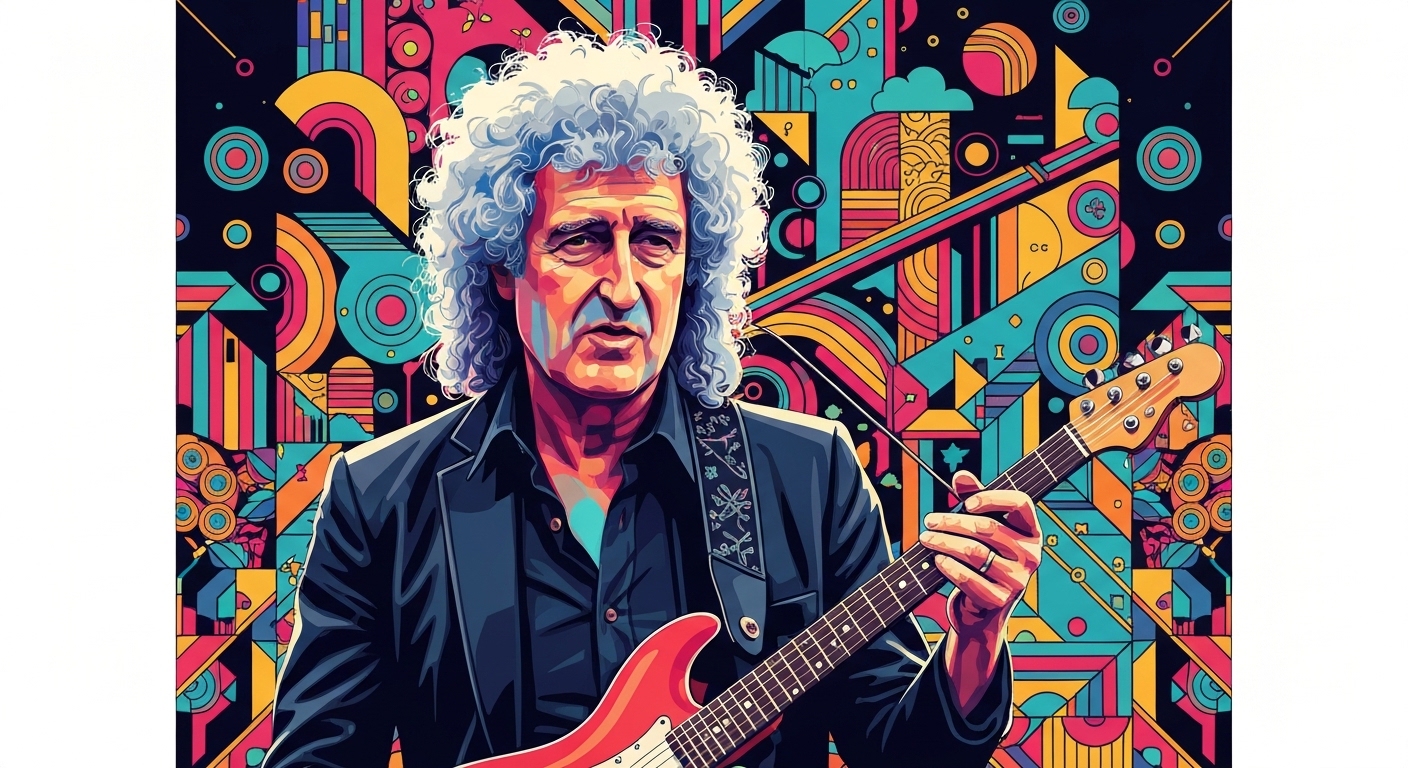
Queen's genre-hopping — glam rock, opera, disco, arena rock, sometimes all four in one song — is part of why the band still lands with new listeners. Nobody else was doing "Bohemian Rhapsody" in 1975. Nobody's really done anything like it since.
Queen's band history and the Freddie Mercury dynamic
Queen formed in London in 1970, with May, Freddie Mercury, Roger Taylor, and later John Deacon rounding out the lineup. May and Mercury's songwriting dynamic was central to the band's sound — May bringing the guitar-driven rock architecture, Mercury bringing the theatrical vocal range and showmanship that turned stadium shows into events. Their creative friction and chemistry reportedly pushed each other to write bigger, stranger, more ambitious songs than either might have alone.
Mercury's death in 1991 could easily have ended the band outright. Instead, May and Taylor have continued performing as Queen with different vocalists over the years, including extensive touring with Adam Lambert. It's not the same band. Nobody pretends it is. But it's a reasonable way to keep the songs alive for audiences who never got to see the original lineup.
Brian May's solo career achievements
Away from Queen, May built a genuine solo career, including the album "Back to the Light" and soundtrack contributions across film and television. His solo work leans into the same layered, orchestral guitar style that defines his Queen contributions, just without three other blokes in the room. It's never eclipsed Queen commercially — nothing was going to — but it's given May a creative outlet that isn't tied to nostalgia tours and box-set reissues.
His work on movie and TV soundtracks
May's fingerprints are on more soundtracks than casual fans realise. His work on the "Masters of the Universe" film score is one of the more surprising entries in his catalogue — a guitarist known for stadium rock, contributing to the sound of He-Man's big-screen outing. It's a reminder that May's musical curiosity extends well past the Queen back catalogue, into scoring work that rarely gets mentioned in the same breath as "Bohemian Rhapsody."
Collaborations and festival appearances — STARMUS and beyond
This is where May's two lives — rock star and scientist — actually collide in public. He's a co-founder and regular participant in STARMUS, a festival that combines science communication with music, bringing together astronauts, Nobel laureates, and musicians on the same stage. It's a genuinely odd combination on paper — physics lectures and guitar solos in the same festival programme — but it works precisely because May isn't faking either half of it. He's not a rock star cosplaying as a science fan. He's the real thing, doing both at once.
His influence on other guitarists
May's layered harmony guitar style and homemade-instrument ethos have influenced generations of players who came after him, from arena rock guitarists chasing that "orchestral" multi-tracked sound to bedroom tinkerers building their own guitars because if Brian May could do it with a fireplace mantelpiece, why can't they. His refusal to switch to a mass-produced guitar, despite decades of stardom and the money to buy any instrument on earth, has made the Red Special almost as recognisable as the man playing it.
The PhD nobody told you about
Here's the part of the Brian May story that doesn't make it into most greatest-hits documentaries. Reportedly, May enrolled at Imperial College London in 1968 to study physics, before Queen existed as a band. He reportedly completed his undergraduate degree with honors in 1971. Then he kept going, working toward a doctorate — his thesis reportedly focused on zodiacal dust and the infrared emission of the sun, essentially studying the dust particles scattered through our solar system and how they radiate heat.
Then, reportedly in 1974, Queen happened. Properly happened — international fame, relentless touring, "Bohemian Rhapsody" happened. May reportedly submitted his doctoral thesis around that time, but the music career took over completely. Decades of touring and recording reportedly consumed what would have been his research years. The PhD didn't get abandoned exactly. It just got paused. For a really, really long pause.
Reportedly, in 2007, May went back to Imperial College to finish what he'd started. After an approximate 17-year hiatus from active research, he reportedly sat his final exams and defended his thesis in 2008 — about 34 years after he first submitted it. He was formally awarded his PhD in May 2008. Three years later, in 2011, he reportedly became Chancellor of Liverpool John Moores University. Imagine explaining that gap in your CV to a recruiter. "Sorry for the delay finishing my doctorate, I was busy writing 'We Will Rock You' and headlining stadiums for three decades." Most universities would laugh you out of the room. Imperial College, reportedly, just let him get on with it.
(Somewhere out there is a PhD student who's been stuck on their thesis for eighteen months feeling bad about it. Brian May would like a word. A comforting one.)
Animal rights activism and personal philosophy
May's public life since the 2000s hasn't just been music and astrophysics — he's also become one of the more visible celebrity voices in animal rights activism in the UK, campaigning against badger culls and fox hunting. It fits a broader pattern with May: once he commits to something, he goes all in, whether that's a guitar built from spare parts, a physics doctorate finished decades late, or a campaign most rock stars wouldn't bother picking up. It's not a side hustle for him. It's treated with the same seriousness as the science and the music.
How to play like Brian May — the actual technique
If you're a guitarist wanting to actually nick some of May's technique rather than just admire it from the cheap seats, here's where to start:
- Ditch the standard pick. May uses a sixpence coin. You don't need actual old currency — a firm, thick pick with a smooth edge gets you closer to that bright, percussive attack.
- Layer your harmonies. May's "orchestral" sound comes from recording multiple guitar tracks with harmonised intervals, not from one guitar doing everything. Try tracking a third or a fifth above your main line.
- Lean on sustain and vibrato. The Red Special's design gives long natural sustain. Emulate it by working on slow, controlled vibrato rather than rapid trembling.
- Treble booster is doing more work than you think. May's signature tone relies heavily on treble boost pedals pushing a cranked amp into natural distortion — less about gain pedals, more about pushing the front end.
Why the PhD story matters more than the hair
Here's my one hot take on this, and I'll die on it: Brian May's PhD is a more interesting story than any guitar solo he's ever played, and most Queen documentaries bury it as a footnote. That's backwards. A 34-year gap between submitting a thesis and defending it isn't a quirky trivia fact — it's a genuinely unusual case study in what happens when you refuse to let one identity cancel out another. Most people who get famous at 24 don't go back to finish the physics degree at 61. May reportedly did.
The actionable bit for anyone reading this mid-career-change or halfway through an abandoned qualification: the "too late now" instinct is wrong more often than it feels. Reportedly Brian May proved that on a 34-year delay. You've probably got less ground to make up than that.
Where I'd push back on the mythology, though: don't treat May's astrophysics work as equivalent to his musical output in terms of daily practice. He built one Red Special and played it for sixty years. He didn't practice astrophysics daily for those 34 years — the PhD was reportedly picked back up, not maintained in parallel the whole time. The two careers ran in sequence more than in true parallel, even if the public story flattens them into "he did both at once." Fair to admire. Not fair to oversimplify.
Who is Brian May?
Brian May is the lead guitarist and co-founder of Queen, known for his homemade Red Special guitar, his songwriting contributions to hits like "We Will Rock You," and his parallel career as an astrophysicist. He's also a vocal animal rights activist and, reportedly, Chancellor of Liverpool John Moores University.
What guitar does Brian May play?
He plays the Red Special, a guitar he and his father Harold built by hand in the early 1960s using materials including an old mantelpiece for the neck. He's played it as his primary instrument for essentially his entire career.
How did Brian May make his own guitar?
May and his father built the Red Special from scratch, reportedly using a fireplace mantelpiece for the neck, motorcycle valve springs for the tremolo arm, and various other salvaged parts. It's a proper shed-built instrument, not a customised factory guitar — which makes its role on some of the biggest rock records ever made even more ridiculous.
Is Brian May better than other rock guitarists?
That's a pub argument with no clean winner, but May's layered harmony style, homemade instrument, and songwriting output put him firmly in the conversation for greatest rock guitarists. What sets him apart isn't raw speed — it's the orchestral, multi-tracked sound nobody else quite replicates.
What is Brian May's net worth?
Brian May's net worth is widely reported in the tens of millions, built from decades of Queen's record sales, touring, songwriting royalties, and solo work. Exact figures vary by source and year, so treat any single number as an estimate rather than gospel.
What songs did Brian May write for Queen?
May wrote or co-wrote several of Queen's biggest songs, including "We Will Rock You," "Fat Bottomed Girls," "Save Me," and "Tie Your Mother Down," alongside major contributions to the band's broader catalogue and arrangements.
What playing techniques is Brian May known for?
He's known for using a sixpence coin as a pick, layering harmonised multi-tracked guitar lines to sound orchestral, relying on treble-booster pedals for his signature tone, and long, controlled sustain and vibrato — much of it shaped by the design of the Red Special itself.
Does Brian May really have a PhD in astrophysics?
Reportedly, yes. He enrolled at Imperial College London in 1968, submitted a thesis on zodiacal dust in 1974, paused for Queen's rise to fame, then returned in 2007 and was awarded his PhD in May 2008 — approximately 34 years after he started.
Why did Brian May stop his PhD in the first place?
Reportedly, Queen's touring and recording schedule from 1974 onward took over his life almost entirely, leaving no realistic time for academic research. The band's rise to global fame effectively paused his physics career for decades rather than ending it outright.
So next time someone brings up Brian May at the pub quiz, don't just reach for "guitarist, big hair, wrote 'We Will Rock You.'" Reach for the version where a bloke pauses his physics doctorate to become one of the biggest rock stars on the planet, then calmly finishes it off 34 years later like he'd just popped out for milk. Turns out the man who taught the world to stomp-stomp-clap was also quietly studying space dust the whole time. Rock and roll, and rocket science. Genuinely no notes.