
Key Takeaways
- Starting July 1, 2026, the EU will impose a mandatory €3 customs fee on all parcels under €150 from outside the bloc
- The fee targets ultra-cheap e-commerce platforms like Shein, Temu, and AliExpress that previously exploited duty-free loopholes
- Prices on imported fast fashion and budget goods will likely rise, making European retailers more competitive
- Member states have lost millions in tax revenue due to the low-value parcel exemption—this fee closes that gap
- The policy affects every shopper buying from outside the EU, not just budget retailers
The EU will impose a €3 customs duty on low-value parcels from outside the bloc starting July 1, 2026, targeting cheap e-commerce imports from platforms like Shein, Temu, and AliExpress to ensure fair competition with European retailers and close a tax avoidance loophole that has cost member states millions in lost revenue. (EU €3 parcel fee explained below.)
Your next Shein haul just got a surcharge
You've probably noticed how a €12 dress from Shein somehow arrives at your door with no customs fee attached. No duty. No fuss. Just a very thin envelope and a vague sense that the economics don't quite add up.

They don't. And the EU has finally noticed.
Starting July 1, 2026, a mandatory €3 fee will be slapped on low-value parcels arriving from outside the EU. Every package. Every platform. Every suspiciously cheap pair of trousers. The EU €3 parcel fee is here, and it changes the maths on ultra-cheap imports for good.
Here's everything you need to know — whether you're a shopper, a seller, or a European retailer who's been watching this situation with the patience of a saint and the frustration of someone who actually pays VAT.
What the EU €3 parcel fee actually is
The EU €3 parcel fee is a mandatory customs charge applied to every low-value parcel entering the EU from a non-EU country. It targets packages valued at approximately €150 or below — the bracket that has historically enjoyed a duty-free exemption.

The fee is flat. €3 per parcel, regardless of whether the item costs €5 or €145. You're not paying a percentage. You're paying a processing charge for the customs infrastructure required to handle the sheer volume of cheap packages flooding into European borders.
Think of it as the EU finally sending an invoice for the admin it's been doing for free. (Nobody likes surprise invoices. The EU doesn't care.)
The fee kicks in on July 1, 2026. That's the hard date. Legislative review is reportedly ongoing through 2024-2025, but the direction is clear.
Shein, Temu, AliExpress — who this really targets
The EU ecommerce parcel tax is technically platform-neutral. Every non-EU parcel under the threshold gets the fee. In practice, three names come up in every policy discussion: Shein, Temu, and AliExpress.
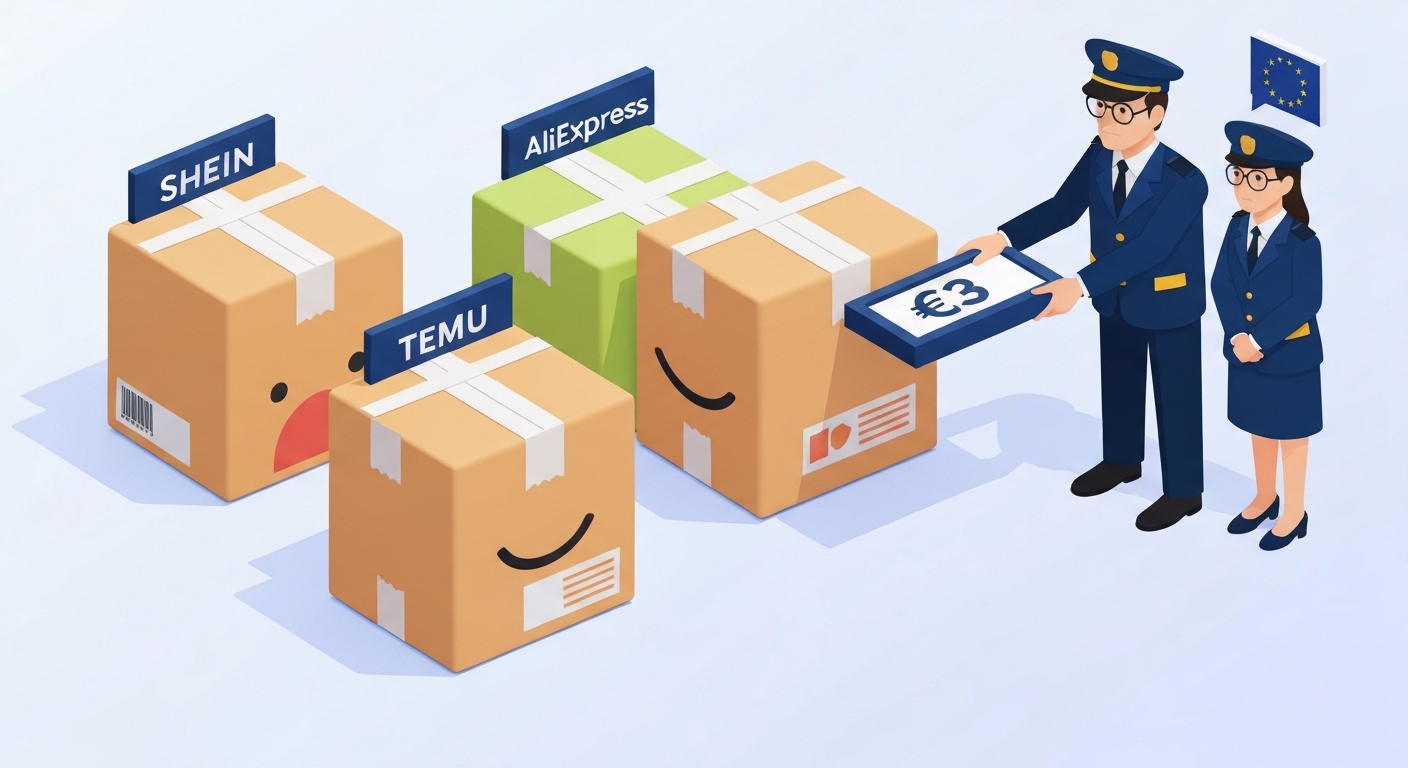
These platforms operate on a model that requires near-zero friction at customs. Their entire competitive advantage rests on getting a €9 item to a customer in Düsseldorf for less than a comparable item made in Portugal. The duty-free exemption on low-value parcels was the structural subsidy that made that possible.
According to reports, ultra-low-cost platforms like these account for approximately 15–20% of EU ecommerce traffic. That is not a rounding error. That is a significant chunk of the market operating under rules that European retailers simply don't benefit from.
A Polish clothing brand pays VAT. A French toy maker pays import duties on materials. A Shein package did not. That asymmetry is exactly what the EU customs fee on cheap parcels is designed to correct.
The €150 de minimis loophole — closed, finally
The de minimis threshold is the technical name for the rule that said: parcels below a certain value don't need to clear customs the normal way. The EU's threshold was set at €150.
In theory, this was a practical measure to avoid customs queues backing up over a book or a birthday gift. In practice, it became a motorway for cheap Chinese imports to enter Europe duty-free at massive scale.
Reports suggest approximately €17 billion in customs duties have been avoided annually through this loophole. That number is disputed, and estimates vary — but even at half that figure, it's a large hole in member states' revenue. The EU is not particularly amused.
The €3 EU customs fee on cheap parcels doesn't eliminate the de minimis exemption entirely. It adds a processing fee on top of it. Think of it as the EU saying: "You can still use the fast lane. But now you pay a toll."
Parallel discussions on VAT harmonisation for low-value imports are also ongoing in EU policy circles — so this €3 fee may be the first of several changes, not a one-and-done fix.
Why the EU is introducing this — the fairness argument
The official rationale breaks into two pillars: fair competition and consumer safety.
On competition: EU retailers have been complaining about this for years. Pre-2024, multiple EU member states reportedly implemented their own customs enforcement initiatives, creating a patchwork approach that satisfied nobody. The €3 fee is a bloc-wide response to a bloc-wide problem.
On safety: cheap parcels often bypass the product safety checks that EU-based sellers must comply with. There have been documented cases of products from non-EU platforms failing EU safety standards — particularly children's toys, electronics, and cosmetics. The EU Shein Temu import fee is partly a revenue measure, and partly a speed bump designed to force more rigorous handling of these shipments.
Fair enough, honestly. If you're selling a face cream in France, it has to pass safety tests. If you're shipping face cream from a warehouse in Guangzhou into France, the current system does not guarantee the same scrutiny. That is a genuine problem, not just protectionism dressed up in policy language.
What this means for your shopping cart — the real consumer maths
Here's where it gets practical. The EU low-value parcel charge of €3 sounds small. But context matters.
If you're buying a €12 item on Temu, that's a 25% surcharge. On a €6 item, it's 50%. On a €150 item, it's 2%. The fee is regressive in the sense that it hits budget shoppers hardest — the ones buying the cheapest items are the ones who feel it most.
Platforms have a few choices in response:
- Absorb the cost and squeeze their already-thin margins further
- Pass it directly to the consumer as a visible line item
- Raise base prices to account for it invisibly
- Bundle multiple items per shipment to reduce per-item fee impact
Realistically, expect a mix of all four. Temu has already shown it will restructure operations when regulations demand it — the platform shifted logistics models for the US market when American trade rules changed. Expect the same playbook for Europe.
The shopper who orders one €8 phone case a week will notice. The shopper who orders a €120 bundle every few weeks probably won't.
Seller compliance guide — three steps, no surprises
If you're a non-EU seller shipping into Europe, here's what you need to do before July 1, 2026. This is not legal advice. This is the practical starting point.
Step 1: Audit your parcel value distribution. Pull your EU order data and identify what percentage of your shipments fall under €150. That's your exposure. If it's most of your volume, the €3 fee is a material cost that needs to appear in your P&L now, not in 2026.
Step 2: Review your customs documentation process. The fee will require collection mechanisms at the customs level. Work with your logistics provider to understand how the €3 will be collected — whether at point of sale, at the border, or via carrier billing. The EU is reportedly planning infrastructure for fee collection as part of the 2025 pre-implementation phase. Stay close to your carrier's updates.
Step 3: Consider bundling and pricing strategy. If you're currently shipping one unit per order, explore whether bundling two or three items per shipment can spread the €3 across higher order values — reducing its percentage impact. Reprice your entry-level SKUs before the fee lands, not after. Reactive repricing looks worse to customers than proactive transparency.
Sellers who treat this as a logistics problem will survive it. Sellers who treat it as someone else's problem will get an unpleasant surprise in their 2026 Q3 results. (You've been warned. That's as close to gentle as this topic gets.)
Real products that get more expensive — concrete examples
The EU ecommerce parcel tax doesn't hit every category equally. Here's what the maths looks like on real product types that dominate low-value cross-border shipments:
- Fast fashion tops (€8–€15): The €3 fee adds 20–37% to the cost. Margins on these are already paper-thin for resellers.
- Phone accessories (€5–€12): Phone cases, cables, and screen protectors. The fee often exceeds the profit margin on individual units.
- Cosmetics and beauty (€10–€30): Already subject to safety scrutiny concerns — the fee adds customs friction that may slow clearance.
- Small toys and gifts (€6–€20): A €3 fee on a €6 toy is effectively a 50% surcharge. This category will either bundle or reprice sharply.
- Electronics accessories (€15–€60): Here the €3 is more manageable — under 20% — but safety compliance issues make this category more likely to face additional scrutiny beyond just the fee.
The items that become genuinely unviable are the ultra-cheap impulse buys — the €3 hair clips, the €5 novelty items. A €3 fee on a €3 item is a 100% surcharge. Expect those to disappear from European listings or move to EU-based fulfilment warehouses.
Strong take: €3 is a floor, not a ceiling
Here's my honest read on this: the €3 EU parcel fee is the opening bid, not the final offer.
The EU has reportedly already flagged that the fee structure may be "adjusted or expanded based on initial implementation data." That is bureaucratic language for "we're starting conservative and watching what happens." The US de minimis debate is moving in parallel, with proposed thresholds dropping from $800 to as low as $200. The direction globally is toward more customs friction on cheap parcels, not less.
If €17 billion in annual customs duties is genuinely being avoided — even at half that estimate — €3 per parcel doesn't recover anywhere near that amount at current volumes. The fee will either need to rise, or be accompanied by VAT enforcement measures that are currently in parallel discussion.
My actual recommendation: Do not design your 2026 ecommerce strategy around the assumption that €3 is the permanent number. Model for €5. Model for potential VAT changes on top. If you're a non-EU seller and Europe is a significant market, the cost of compliance infrastructure now is cheaper than the cost of reactive scrambling when the rules change again in 2027 or 2028.
If you're a European retailer, this is genuinely good news — but don't expect it to level the playing field overnight. Platforms like Shein have logistics operations, pricing algorithms, and supply chains that can absorb €3 more easily than you might hope. The European Parliament has been pushing for broader measures beyond just a fee, including stricter product safety enforcement. That's the longer-term story worth watching.
And for shoppers: yes, cheap imports will get slightly less cheap. But the products that were passing safety checks and paying fair taxes were never the problem. The ones that weren't? €3 is the least of their issues.
What is the EU €3 parcel fee?
It's a mandatory €3 customs charge applied to every parcel valued at approximately €150 or below entering the EU from outside the bloc. It starts on July 1, 2026. The fee is flat — meaning it applies to a €5 item and a €145 item equally. Think of it as a toll booth that previously had the barrier up. It's coming down.
Which retailers does the EU €3 fee target?
Technically all non-EU sellers shipping low-value parcels into Europe. In practice, the policy is squarely aimed at ultra-low-cost platforms — primarily Shein, Temu, and AliExpress — which reportedly account for approximately 15–20% of EU ecommerce traffic. These platforms have built their entire model around the duty-free advantage that this fee begins to erode.
How will the EU parcel fee affect Shein and Temu prices?
Expect prices to rise on the cheapest items — those under €15 — where the €3 fee represents the largest percentage surcharge. Platforms may absorb some of the cost, bundle items per shipment to spread the fee, or raise base prices proactively. A single €8 item from Temu becomes effectively €11 once the fee lands. That's not nothing.
How does the EU €3 fee compare to the old €150 duty exemption?
The €150 de minimis exemption meant parcels under that value cleared customs without paying import duties. The €3 fee doesn't replace that exemption — it adds a processing charge on top of it. You still get the exemption on duties above €150. You just now pay €3 for the privilege of the fast lane. The EU is calling it a customs handling fee, not a tariff.
How much will the new EU parcel fee cost consumers?
€3 per parcel, collected at customs. For a €12 item, that's a 25% increase. For a €60 item, it's 5%. The impact is most significant on budget shoppers buying single low-value items frequently. Shoppers who bundle orders or buy higher-value items will barely notice. The maths are simple — the politics are not.
Why is the EU introducing a fee on cheap parcels?
Two reasons: fair competition and consumer safety. EU retailers pay VAT and comply with product safety regulations that non-EU platforms shipping direct to consumers largely bypassed. Reports suggest approximately €17 billion in customs duties are avoided annually through the low-value exemption. The EU decided that running a charity for overseas logistics operations wasn't in the job description.
How does the EU parcel fee impact the de minimis threshold?
The de minimis threshold of €150 technically remains. Parcels below that value still don't pay full import duties. But the €3 flat fee applies regardless. Think of it as the threshold surviving, but gaining a toll booth at the entrance. Parallel VAT harmonisation discussions suggest further changes to de minimis rules may follow after the fee is established.
Will the EU €3 fee actually stop cheap imports from China?
No — and it's not designed to. The fee adds friction and recovers some processing costs. It won't stop Shein or Temu. Platforms at that scale can absorb or restructure around €3. What the fee does is begin closing the structural advantage — and signals that more enforcement is coming. Consider this the first move, not checkmate.
When does the EU €3 parcel fee start?
July 1, 2026. Legislative review is reportedly ongoing through 2024–2025, with fee collection infrastructure expected to be built out in the pre-implementation phase. If you're a seller, that gives you roughly a year to audit your parcel mix, adjust pricing, and talk to your logistics provider about how the fee gets collected at the border.
Does the EU €3 fee apply to all parcels or just certain platforms?
All low-value parcels from non-EU countries, regardless of platform. That includes individual sellers on AliExpress, direct-to-consumer Chinese brands, and any non-EU retailer shipping packages valued under approximately €150 into Europe. It is not platform-specific in law. In practice, the volume impact lands heaviest on the platforms shipping millions of cheap parcels weekly.
The bottom line
The EU €3 parcel fee is not a dramatic plot twist. It's the logical conclusion of a policy debate that's been simmering since at least 2021. A flat €3 charge on low-value imports, starting July 1, 2026, closing a loophole that reportedly let €17 billion in duties walk out the door annually.
Shoppers will pay a little more on cheap parcels. Sellers need to audit their exposure now, not in 2026. European retailers get a structural advantage they've been asking for. And Shein gets a €3 bill — which, at their volume, is less a punishment and more a parking fine.
The real question isn't whether €3 changes everything. It's whether €3 is just the beginning. Spoiler: it probably is. Plan accordingly — or spend 2027 explaining to your accountant why you didn't.
(At least the parcel will still arrive. Just with a slightly heavier price tag. You could say the EU finally decided to deliver on its customs promises. I'll see myself out.)