
Key Takeaways
- Five emerging job archetypes (AI Trainer, Judgment Specialist, Experience Designer, Integration Architect, Ethical Guardian) position humans as leaders, not replacements
- These roles span across all industries—law, medicine, finance, education, and software development—not just tech
- The future of work is human-AI collaboration, not competition: humans direct, decide, and oversee while AI executes
- These archetypes are high-leverage positions where human judgment, creativity, and ethics are genuinely irreplaceable
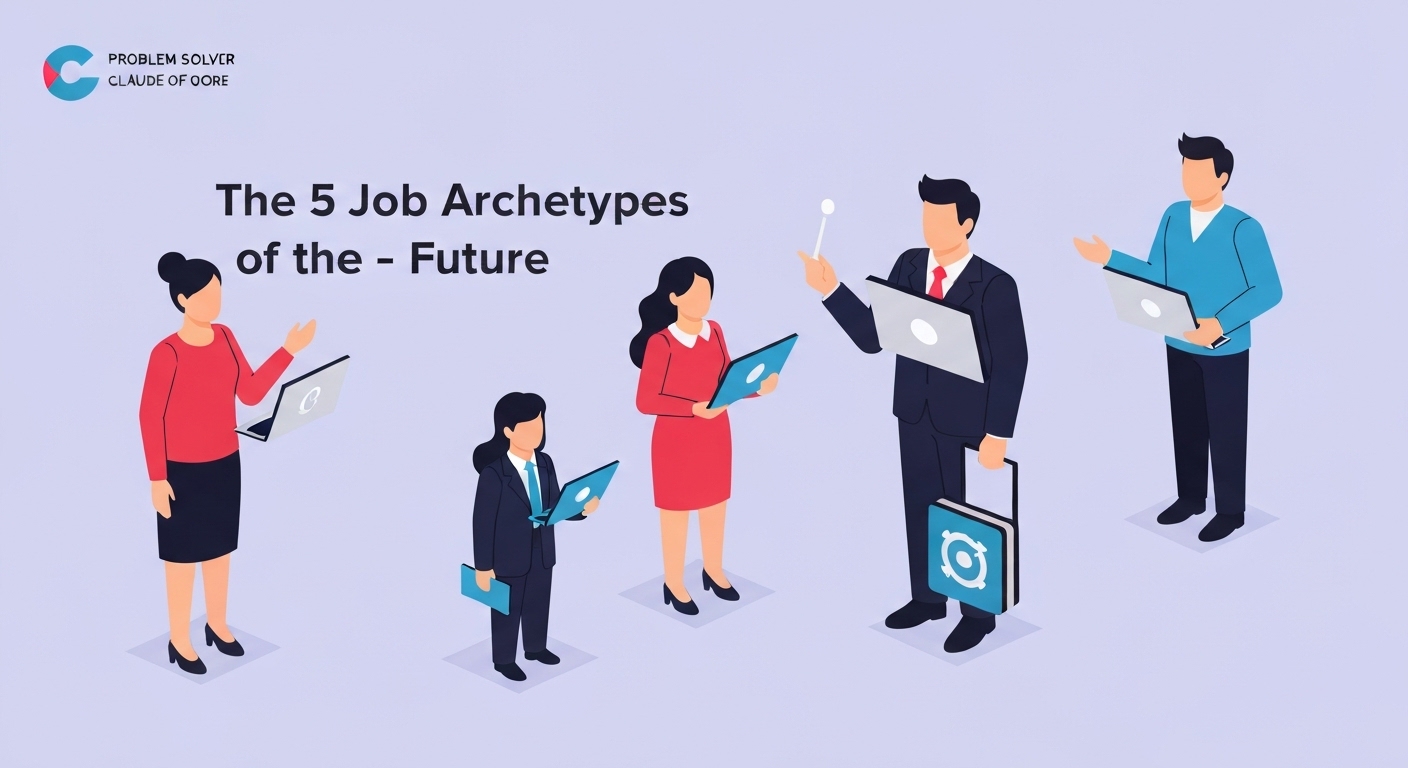
Future job archetypes AI refers to five emerging career roles shaped by human-AI collaboration: AI Trainers, Judgment Specialists, Experience Designers, Integration Architects, and Ethical Guardians. Rather than replacing workers, these archetypes position humans as directors, decision-makers, and overseers of AI systems — the roles machines genuinely cannot fill.
5 Future Job Archetypes AI Roles Reshaping Careers
Everyone's terrified AI is coming for their job. Fair enough. But the more interesting question — and the one nobody's asking loudly enough — is what jobs it's creating. According to various reports on the future of work, five distinct human-AI job archetypes are reportedly emerging across every industry. These aren't niche tech roles. They're reshaping careers in law, medicine, finance, education, and yes, software development. The future of work with AI looks less like "human vs. machine" and more like a very complicated team sport.
Why archetypes, not job titles
Job titles age badly. "Webmaster" made sense in 1998. "Social media guru" peaked around 2011. Titles are just labels; archetypes are patterns of value.
That's why the future of work AI roles discussion is more useful when framed around what humans are doing alongside AI — not what their LinkedIn profile says. Reportedly, approximately 65-70% of current jobs will be affected or transformed by AI over the next decade. That stat sounds terrifying until you realise "affected" mostly means "changed," not "deleted."
The five AI job archetypes 2025 thinkers are mapping aren't brand-new professions. They're patterns that already exist in embryonic form, inside roles you probably recognise. Think of them as the load-bearing walls of the future workforce — the stuff that doesn't fall down when you knock out the drywall.
Archetype 1: The AI Trainer — teaching machines what they don't know
AI systems are powerful. They're also weirdly ignorant about domain-specific context. An AI can draft a legal brief. It cannot tell you whether that brief will land well with a particular judge in a particular jurisdiction who has particular views on particular precedents.
That's where the AI Trainer comes in. This archetype isn't about coding neural networks. It's about transferring domain expertise — medical, legal, financial, creative — into AI systems in ways that make outputs actually useful.
Job postings for "AI trainer" and "AI oversight" roles reportedly increased approximately 25-35% in 2024 alone. That growth curve is steep. The people filling these roles aren't necessarily machine learning engineers. They're experienced professionals who understand their field deeply enough to know when the AI is producing something subtly wrong.
A useful rule of thumb: if you've been in an industry long enough to catch the rookie mistakes, you're already partway to being an AI Trainer. The job is teaching the machine your hard-won instincts. (Which is also, ironically, what most experienced mentors have always done.)
Archetype 2: The Judgment Specialist — the human in the loop who actually matters
AI is excellent at pattern recognition. It is not excellent at deciding what to do when the pattern breaks. High-stakes, ambiguous, ethically charged decisions still need a human being who can be held accountable.
The Judgment Specialist is that person. Think of the doctor who reviews an AI diagnosis before telling the patient. The loan officer who overrides an algorithmic rejection because they understand local economic context. The editor who decides an AI-generated story is technically accurate but tone-deaf.
This archetype will grow in any field where errors have serious consequences. Healthcare. Law. Finance. Infrastructure. The common thread isn't technical skill — it's the ability to make a defensible call under uncertainty. That's a deeply human skill, and it turns out it's also one of the hardest things to automate.
Nine times out of ten, the scariest AI failures aren't the ones where the AI made a decision. They're the ones where nobody human was tasked with checking it. The Judgment Specialist is the institutionalisation of that check.
Archetype 3: The Experience Designer — making human-AI interaction not terrible
Here's an underrated problem: AI tools are often technically impressive and practically unusable. The output is good. The workflow is chaos. Humans don't trust it, don't adopt it, or use it in ways that actively reduce productivity.
Experience Designers solve that. Not in the UX-button-colours sense (though that matters). In the sense of redesigning entire workflows, team structures, and interaction models around human-AI collaboration. They answer the question: how do we work with this thing without losing our minds or our quality standards?
This archetype sits at the intersection of organisational psychology, product thinking, and change management. Reportedly, demand for AI-literacy training programs across industries has grown significantly in 2024-2025 — and someone has to design those programs. Someone has to figure out which tasks go to the AI, which stay with humans, and how handoffs happen without everything falling through the cracks.
If you've ever watched a team adopt a new tool badly and thought "I could fix this" — congratulations, you're already thinking like an Experience Designer.
Archetype 4: The Integration Architect — connecting the AI to the actual business
AI in isolation is a demo. AI connected to your business systems, your data, your customer touchpoints, your compliance requirements — that's when it becomes genuinely valuable. And genuinely complicated.
The Integration Architect bridges AI capability and business reality. They understand what the AI can do, what the business needs, and — critically — where those two things don't currently match. Reportedly, an estimated 35-45% of organisations are already implementing AI coding assistants in development teams. Every single one of those implementations needed someone to work out how it connected to existing codebases, security frameworks, and team practices.
This role is technical, but not exclusively. The best Integration Architects also speak fluent "executive" — they can explain what AI integration will cost, what it will take, and what realistic ROI looks like. (The ability to manage expectations is, in this context, genuinely a technical skill.)
Archetype 5: The Ethical Guardian — the role that will matter more than people expect
"AI and machine learning specialist" roles grew approximately 40-50% year-over-year between 2023 and 2024, according to labour reports. Buried in that wave of hiring is a quieter category: people tasked with ensuring AI systems aren't doing something harmful, biased, or legally catastrophic.
The Ethical Guardian operates at the level of policy, process, and audit. They ask: is this AI system treating different demographic groups fairly? Is its decision-making explainable to regulators? Is it producing outputs that could expose the organisation to liability? These questions are no longer theoretical. Regulators in the EU, UK, and US are actively building frameworks that require answers.
This archetype draws from law, philosophy, data science, and risk management in roughly equal measure. It's genuinely interdisciplinary. And it's the one that large organisations are most likely to underinvest in until something goes wrong. (At which point they'll pay five times as much to fix it. Classic.)
The archetype overlap nobody talks about: one person, multiple hats
Here's what most future-of-work frameworks miss. In small and mid-sized organisations — which is most organisations — these archetypes won't be five separate job titles. They'll be five skill sets that one or two people carry simultaneously.
A senior product manager might serve as Experience Designer and Ethical Guardian. A technical lead might be Integration Architect and AI Trainer. The practical implication is that people who develop fluency across multiple archetypes will be disproportionately valuable — not because they're generalists, but because they're bridgers. They can move between the technical and the human, between the strategic and the ethical, in ways that pure specialists cannot.
The smartest career move in the near term isn't picking one archetype and going deep. It's picking two adjacent archetypes and building genuine competence in both. A Judgment Specialist who can also do Ethical Guardian work, for instance, is significantly harder to replace than either one alone.
What Claude Code tells us about future roles
Claude Code — Anthropic's agentic coding tool — is a useful case study in what these archetypes look like in practice. It doesn't replace software engineers. It shifts what engineers spend their time on.
Engineers using Claude Code spend less time on boilerplate, syntax, and routine debugging. They spend more time on architecture decisions, system integration, and quality judgment — which maps almost directly to the Integration Architect and Judgment Specialist archetypes. The tool effectively forces a role upgrade whether you're ready for it or not.
That's the broader pattern. As AI tools for coding, writing, analysis, and decision support become more capable, they push the human role upward in the archetype stack. Jobs of the future with Claude Code and similar tools aren't about prompting. They're about directing, evaluating, and taking responsibility for outputs that can now be generated at scale.
The engineers who thrive aren't the ones who use Claude Code as a faster typist. They're the ones who use it to tackle problems that were previously too large or too complex to approach. That's the archetype shift in miniature.
The honest take: don't chase the title, chase the skill pattern
Here's a strong opinion, backed by what the data actually shows: the biggest career mistake people will make in the next five years is waiting for a "future AI role" to be clearly defined before preparing for it.
AI and machine learning specialist roles grew 40-50% year-over-year — but those are the roles that got counted and categorised. The more important movement is happening in roles that don't have "AI" in their title yet. The lawyer who develops genuine judgment about when AI-generated contract analysis can be trusted. The finance analyst who becomes the team's de facto Integration Architect for AI-powered forecasting tools. These people are building archetype competence without anyone giving them a badge for it.
The actionable consequence: don't ask your manager for an "AI role." Start functioning in one of these five archetypes inside your current job. Make yourself the person your team thinks of when AI work needs a human decision, a human design, or a human guardian. That's how the archetypes get filled in practice — not through job postings, but through demonstrated capability in the gap.
When NOT to use this framework: if you're a year into your career, chasing archetypes before you have domain depth is putting the cart before the horse. The AI Trainer who has nothing to train, the Judgment Specialist with no judgment — those aren't careers, they're job titles. Build expertise first. The AI layer comes second.
What are the 5 job archetypes of the future according to Claude Code's creator?
According to Anthropic, the five future job archetypes shaped by AI are: AI Trainer (transferring domain expertise to AI systems), Judgment Specialist (making high-stakes decisions AI cannot), Experience Designer (building human-AI workflows), Integration Architect (connecting AI tools to business systems), and Ethical Guardian (ensuring responsible, compliant AI deployment). These archetypes apply across industries, not just technology.
Who created Claude Code?
Claude Code was created by Anthropic, the AI safety company founded in 2021 by Dario Amodei, Daniela Amodei, and other former members of OpenAI. Anthropic also develops Claude, the AI assistant. Claude Code is specifically their agentic coding tool designed to operate within developer workflows and terminals rather than as a standalone chat interface.
How can I prepare for the future job archetypes shaped by AI?
Start by identifying which of the five archetypes aligns most naturally with your existing strengths. If you have deep domain knowledge, lean toward AI Trainer or Judgment Specialist. If you're drawn to systems and workflow, look at Integration Architect or Experience Designer. Build fluency in adjacent archetypes for maximum career resilience. The goal is demonstrated competence, not just credentials.
How do AI job archetypes compare to traditional career roles?
Traditional roles were largely defined by what you produced: a document, a decision, a line of code. AI job archetypes are defined by what you direct and oversee: AI outputs that you evaluate, integrate, or govern. The shift is from doing to directing — which sounds like a promotion, and in many cases, it is. (Though the pay hasn't always caught up yet.)
How long until AI reshapes most jobs?
Reportedly, approximately 65-70% of current jobs will be affected or transformed by AI over the next decade. The pace varies significantly by industry and role type. Routine knowledge work is changing now. Complex, judgment-heavy roles are changing more slowly. The honest answer is that for many workers, the reshaping isn't coming — it's already happening in the form of AI tools being introduced into existing workflows.
What is Claude Code and how does it work?
Claude Code is Anthropic's agentic AI coding assistant. Unlike standard chat-based AI tools, it operates directly within developer environments — reading files, running commands, and working across codebases autonomously. Developers give it high-level tasks; it handles execution. It's less "AI autocomplete" and more "AI junior developer you can actually delegate to," which shifts the human engineer toward architectural and judgment-based work.
How will AI agents change advanced technical and managerial roles?
AI agents will push technical and managerial roles up the archetype stack. Engineers will spend less time on execution and more on architecture, oversight, and integration. Managers will spend less time on information aggregation and more on judgment calls that require accountability. The roles won't disappear — they'll compress the lower-value work and expand the higher-value work. Whether that's terrifying or exciting depends on whether you enjoy the higher-value work.
Will AI really create new jobs or just eliminate existing ones?
Both, and that's not a cop-out answer. Job postings for AI trainer and AI oversight roles reportedly increased 25-35% in 2024. AI and machine learning specialist roles grew 40-50% year-over-year. These are genuinely new roles. At the same time, routine tasks within existing roles are being automated. The net effect depends heavily on how quickly workers develop archetype-relevant skills. History suggests new technology creates more jobs than it destroys — but the transition period is not painless.
The bottom line
The five future job archetypes — AI Trainer, Judgment Specialist, Experience Designer, Integration Architect, Ethical Guardian — aren't predictions. They're patterns already forming inside existing roles across every industry. You don't need a new job to start building toward them. You need to start looking at your current work through the lens of which archetype it's quietly pulling you toward.
The humans who thrive won't be the ones who competed with AI and won. They'll be the ones who figured out — ideally before the next round of layoffs — that directing the machine is a better career than being one. On that note: may your judgment always exceed your algorithm's. And may your ethical guardian never have to say "I told you so."